
The playground was a battleground of whispers and jeers, where the girl on crutches was the unwelcome intruder. Emily Kingsley stood on the edge, her prosthetic leg gleaming in the bright sun, her pale hands gripping the silver crutches that kept her upright. The ball rolled toward her, a fleeting opportunity, but before she could reach it, a cruel hand snatched it away, and laughter rippled through the crowd like a jagged wave. Phones were raised, not to capture joy, but to immortalize her humiliation. She wasn’t just invisible: she was a target.
Then, from the sidelines, an unexpected figure emerged: Noah, a barefoot, homeless boy with a ripped sweatshirt, torn jeans, and a threadbare backpack slumped beside him. His dark eyes fixed on Emily, not with mockery, but with quiet understanding. He picked up the ball and gently placed it in her hands. Exclamations spread like wildfire, and mocking laughter gave way to an awkward silence. For the first time, Emily was no longer alone.
The usual cacophony of the playground faded as they began to play—passing, catching, passing again—each movement a defiant act against the cruelty that had left Emily incapacitated. Noah’s bare feet struck the cracked asphalt with surprising grace, each throw measured and accurate, giving Emily the confidence to catch, to laugh, to feel part of the experience. The circle of children watched, their mocking smiles turning to disbelief; some lowered their phones, the story they thought they were recording slipping through their fingers.
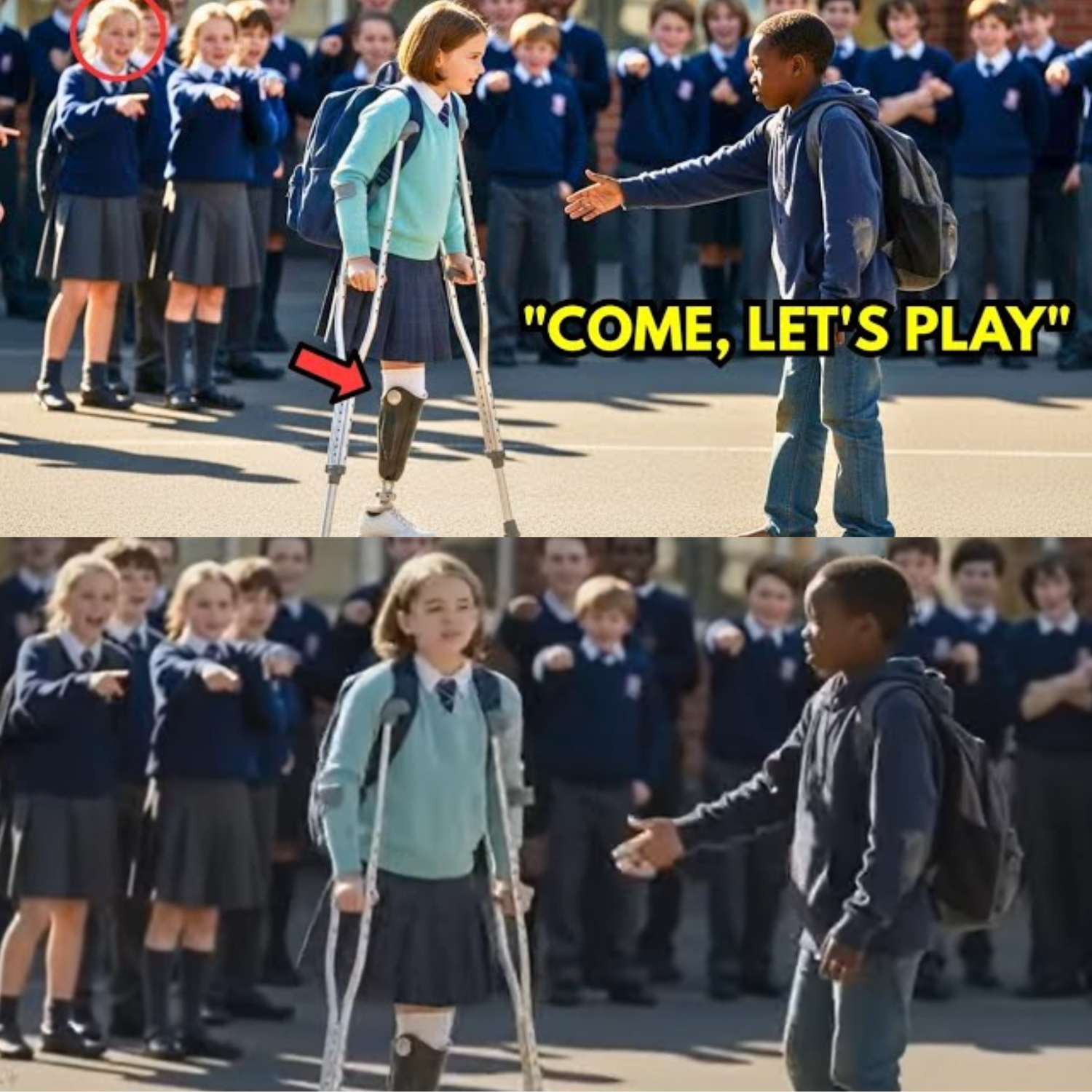
Emily’s blue eyes shone with a fragile hope; her smile, trembling but genuine, and her crutches were no longer symbols of weakness, but testaments to resilience. Noah’s presence was a shield, a declaration that kindness could emerge from the most unexpected places. Together, they rewrote the rules of the game, transforming contempt into solidarity.
But then, the moment shifted. A sleek, black luxury sedan pulled up, its elegant presence cutting through the tension of the playground. Daniel Kingsley, Emily’s billionaire father, stepped out; his tailored navy suit and silver tie gleamed in the sunlight. The crowd fell silent, the dancing suspended in mid-air as all eyes turned to him. Emily’s heart pounded with fear: Would he be ashamed? Would he snatch this fragile victory away from her?
Noah, too, froze, caught between two worlds: the harshness of his life and the opulence embodied by Daniel Kingsley. The billionaire’s gaze swept over his daughter and then settled on Noah. The silence grew heavier, whispers swirling: Was this a punishment? Or something more?
Daniel bent down slowly, picked up the ball, and examined it as if it were a precious object. Then, in a firm voice that silenced the murmurs, he placed it in Noah’s hands. “This,” he said, “is the kind of friend my daughter deserves.” The words hung in the air, heavy with meaning. Gasps rippled through the crowd, eyes widened, and the satisfaction of the crowd turned to embarrassment.
Emily’s shoulders relaxed, feeling a weight lifted with relief. Daniel’s hand rested gently on Noah’s shoulder, not as a gesture of charity, but of respect. “You saw his courage when others refused,” he continued, “and that makes you greater than all their laughter.” The playground, once a scene of cruelty, was now a space of acceptance.
Noah clenched his jaw, his eyes darting between father and daughter, unaccustomed to praise, but buoyed by its power. Emily balanced on her crutches, the ball between them, and for the first time, she felt whole, not because of what she lacked, but because someone finally saw her.
The game didn’t resume. It didn’t need to. The moment itself was a victory, a profound rewriting of belonging. The girl, once mocked, and the boy, once invisible, remained together, tearing down walls built by fear and prejudice.
The news spread quickly through the school that afternoon. What should have been a story about the failure of the billionaire’s disabled daughter became the story of the barefoot boy who dared to step forward. The same children who had laughed now whispered in amazement, their attitudes changing as they grasped the truth of courage and kindness.
Emily walked lighter after that day, not because her crutches weighed less, but because she carried something new: proof of belonging. Noah, once invisible in the wealthiest corner of the city, now bore a name full of dignity.
This story isn’t about wealth or perfection. It’s about courage. It’s about kindness. It’s about choosing to speak out when the world remains silent. If this touched you, share it. Let others see how one act of bravery can change the minds of an entire crowd. And subscribe for more stories where the underdogs become the great heroes.