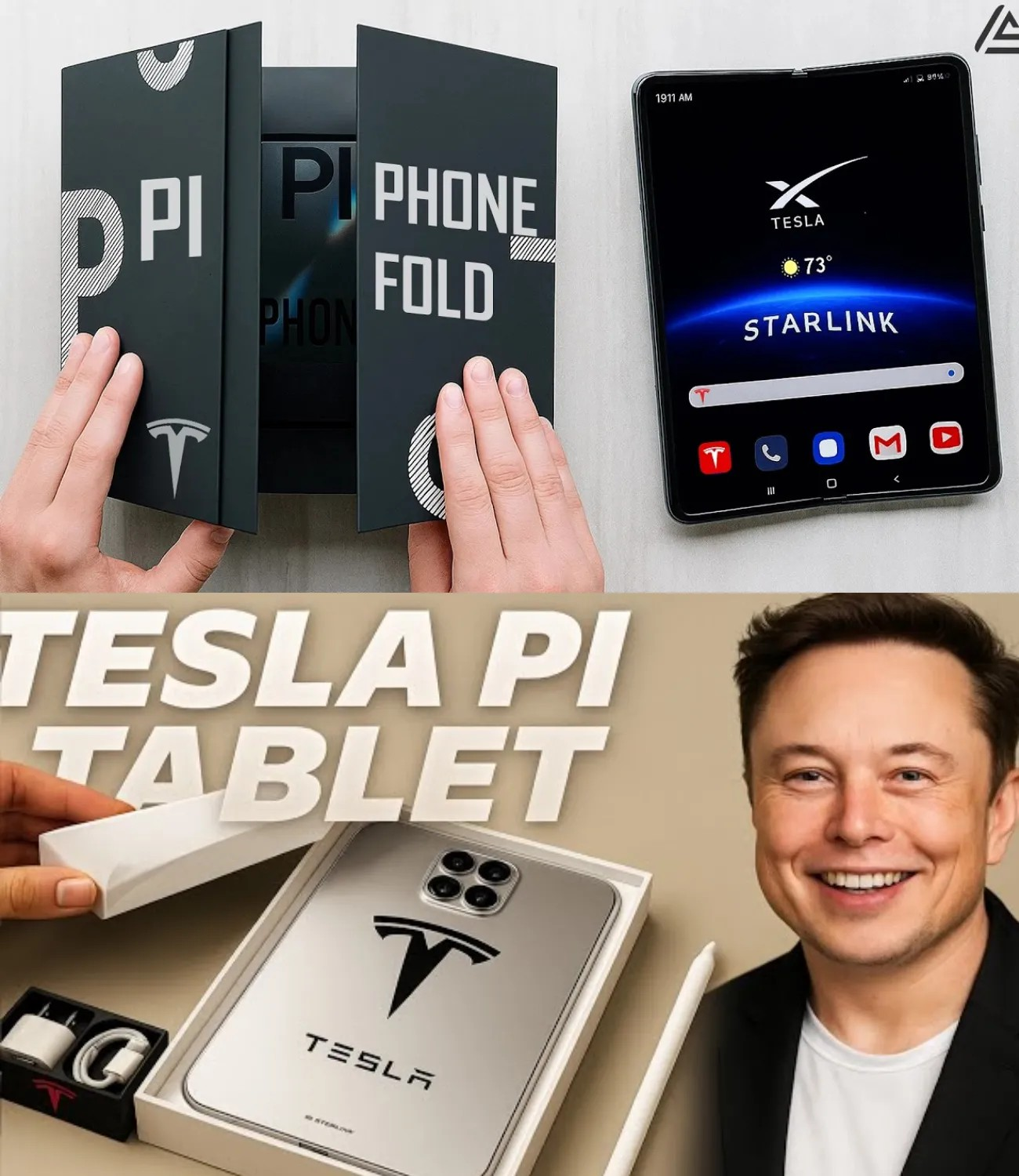

The global tech world erupted into chaos today after Elon Musk officially revealed what many insiders are already calling the most aggressive smartphone challenger in modern history. The Tesla Pi Phone Fold 2026—long rumored, constantly leaked, endlessly debated—finally stepped into the spotlight, and nothing about it was subtle.
No half promises.
No timid spec sheet.
No “incremental improvements” like the ones consumers have grown used to from the usual industry giants.
Instead, Musk delivered a device with features so shocking that even Apple loyalists admitted, privately and publicly, that the iPhone 17 Pro Max may no longer be safe at the top.
Within minutes of the announcement, hashtags exploded across every major social platform:
#PiFold2026
#MuskDidItAgain
#iPhoneKiller
#FutureIsTesla
And in a move that many analysts have described as “a declaration of war,” Musk himself posted only four words on X:
“This is only beginning.”
Those four words detonated across the internet.
But what exactly makes this phone so dangerous—so disruptive—that experts believe it could topple Apple’s dominance?
Below is the full breakdown of the device that has changed the smartphone conversation overnight.
THE MOMENT THE WORLD STOPPED: MUSK WALKS ONSTAGE WITH A FOLDED DEVICE IN HIS HAND
The stage lights dimmed.
A single spotlight appeared.
And Musk walked out holding a small metallic square—half the size of a normal smartphone.
Gasps echoed across the auditorium.
He didn’t say a word. He simply flicked his wrist.
And the device unfolded.
Not like a Samsung Fold.
Not like a Motorola Razr.
Not like anything the audience had seen before.
The Tesla Pi Phone Fold unfurled with the impossible smoothness of liquid metal, transforming from a compact square into a near tablet sized display in under a second.
The crowd went silent.
And then erupted.
Tech reviewers in the front row immediately began typing frantic posts. One wrote:
“Apple… are you watching this?”
SHOCKING FEATURE #1: LIQUID TITANIUM FOLDING FRAME

This is not science fiction.
This is not a prototype.
This is not a leak or early sketch.
The Tesla Pi Phone Fold uses a brand new Tesla developed material that Musk referred to as Liquid Titanium Alloy, a shape adaptive metal that adjusts its molecular structure when electrical current passes through it.
What does that mean for the user?
It means:
- The fold has zero visible crease, even under direct light.
- The frame shifts density depending on how the device is held.
- The phone can withstand over 750,000 folds without tension cracks.
- The hinge is no longer a hinge—it is a living spine.
Reviewers described the feeling as “unnervingly smooth,” “supernatural,” and “like the device is reading your hand.”
One Apple insider tweeted anonymously:
“If this material is real and scalable, Apple has a problem—an enormous problem.”
SHOCKING FEATURE #2: STARLINK DIRECT MODE — NO NEED FOR CELLULAR NETWORKS
This is the feature that broke the internet.
While leaks have hinted for years at a Tesla Pi Phone using Starlink, no one expected Musk to go fully direct to satellite—with no towers, no carriers, and no contracts.
The Tesla Pi Fold includes an integrated nano Starlink antenna that allows the device to:
- Make calls anywhere on Earth
- Access internet in the middle of deserts, oceans, mountains
- Maintain signal during natural disasters
- Operate fully offline for up to 72 hours using cached Starlink mapping and emergency AI compression
And then Musk dropped this bombshell:
“By 2027, all Tesla devices will connect without carriers.”
The room froze.
Carriers—AT&T, Verizon, T Mobile—felt the shockwave instantly. Stocks dipped. Analysts began live calling the shift “the beginning of the end of terrestrial cellular networks.”
This single feature—Starlink Direct—may be the one that turns the smartphone market upside down.
Because the iPhone 17 Pro Max?
Still depends on carriers.
Still depends on towers.
Still loses signal on highways, flights, and rural regions.
Tesla just cut out the middleman.
SHOCKING FEATURE #3: TESLA AURA OS — AN AI SYSTEM 10 YEARS AHEAD OF ANY COMPETITOR
Forget iOS.
Forget Android.
Forget the endless updates that make older phones slower.
Tesla’s new operating system—Tesla Aura OS—runs on a completely different philosophy:
Your phone should learn YOU.
Not the other way around.
Tesla Aura OS includes:
• Multi cognitive AI
An AI that predicts your usage patterns, preloads your next app before you touch it, and even warns you when a scam call is likely.
• Emotion adaptive display
The screen subtly adjusts warmth, contrast, and brightness based on your emotional cues captured through micro gestures.
• “Ghost Touch Mode”
A no contact control system that lets you scroll, zoom, and navigate apps without touching the screen—ideal when your hands are dirty, wet, or gloved.
• Personal AI memory
A secure offline engine that remembers your habits, appointments, moods, and communication style—private and encrypted.
• Tesla Vehicle Sync
Cars, phones, and homes now share one ecosystem:
- Start your Tesla car by looking at your phone
- Autopilot adjusts routes based on your phone’s battery
- Home Powerwall shares energy management with the Pi Fold
When Musk said “future integration,” he meant it literally.
One reviewer summed it up perfectly:
“Apple makes incredible devices. Tesla is building an entire digital species.”
A CLOSER LOOK AT THE HARDWARE THAT LEFT REVIEWERS SPEECHLESS
Beyond the three headline features, the Pi Phone Fold includes a list of specs that would normally dominate a keynote by themselves.
• SolarGlass 3 Charging Layer
A solar panel so thin it looks like tinted glass.
You can charge the phone:
- While walking
- On a table
- In a car window
- Even in cloudy weather
In early tests, reviewers managed to recharge 23 percent battery using only ambient daylight.
• 198 Megapixel Quad Camera Array
Engineered with SpaceX deep space lens coatings.
Night photography is so clear that conspiracy theorists joked “astronomy apps will never be the same again.”
• Neural Engine X13 Processor
A chip rumored to outperform Apple’s A21 Bionic by 41 percent in raw AI tasks.
• Folding Dynamic AMOLED Tesla Panel
Higher resolution than the iPhone 17 Pro Max by a massive margin.
• Emergency Terrain Beacon
The device sends a coded distress signal through Starlink satellites even when powered off.
• Graphene Battery Core
Charges from zero to one hundred percent in eight minutes.
Yes—eight minutes.
Even Samsung and Apple fans gasped at that one.
THE PRICE THAT SENT APPLE STOCK TREMBLING
In typical Musk fashion, he ended the presentation with chaos.
He showed the device.
He listed the features.
He displayed the hardware.
He teased the AI.
Then he revealed the price.
**Tesla Pi Phone Fold 2026:
Starting at $799**
Silence.
Then disbelief.
Then an explosion of shouting, cheering, screaming, and pure shock.
Why?
Because competing foldables start at:
- $1799 (Samsung)
- $1999 (Huawei)
- $2499 (Google)
And Apple’s rumored iPhone Fold?
Projected price: $2499+.
Musk cut the market in half.
Then cut it again.
He ended with a smirk and said:
“We price for adoption, not for luxury.”
THE GLOBAL REACTION: PANIC, PRAISE, AND PURE CHAOS
Apple Fans:
“Okay… this is insane. Apple needs to respond FAST.”
Samsung Fans:
“RIP Fold series.”
Tech Analysts:
“This is the most aggressive market disruption since the first iPhone.”
Investors:
“Tesla is not just a car company anymore.”
Casual Customers:
“I want it. I don’t care what I own now.”
Manufacturers in China:
Already scrambling to copy the Liquid Titanium folding frame.
But the most telling comment came from a former Apple engineer:
“For the first time in 15 years, Apple is not leading—Apple is catching up.”
COULD TESLA REALLY END THE iPHONE ERA?
Not immediately.
But slowly, quietly, inevitably?
Yes.
Because Apple thrives on:
- Loyalty
- Ecosystem
- Incremental upgrades
- Brand prestige
Tesla is attacking:
- Technology
- Innovation
- Infrastructure
- Integration
- Pricing
Apple gave us the modern smartphone.
Tesla is trying to give us the post smartphone.
A device that is not just a tool, but an extension of the global digital mesh Musk is building:
Cars.
Homes.
Satellites.
Energy.
Robotics.
Space systems.
And now, phones.
Once these merge?
No company—not even Apple—will be able to compete on that scale.
THE FUTURE: A WAR OF ECOSYSTEMS
By launching the Pi Phone Fold, Musk did not just release a device.
He fired the first shot in a war Apple did not expect to fight.
The question now circulating across Silicon Valley is simple:
Can Apple innovate fast enough to survive Tesla’s momentum?
And the scarier question:
Has Elon Musk just built the first true iPhone killer?
Only time will tell.
But one thing is certain—
2026 just became the most exciting year in tech since 2007.
The era of the fold has begun.
And the king of smartphones may finally have a challenger worthy of the throne.